
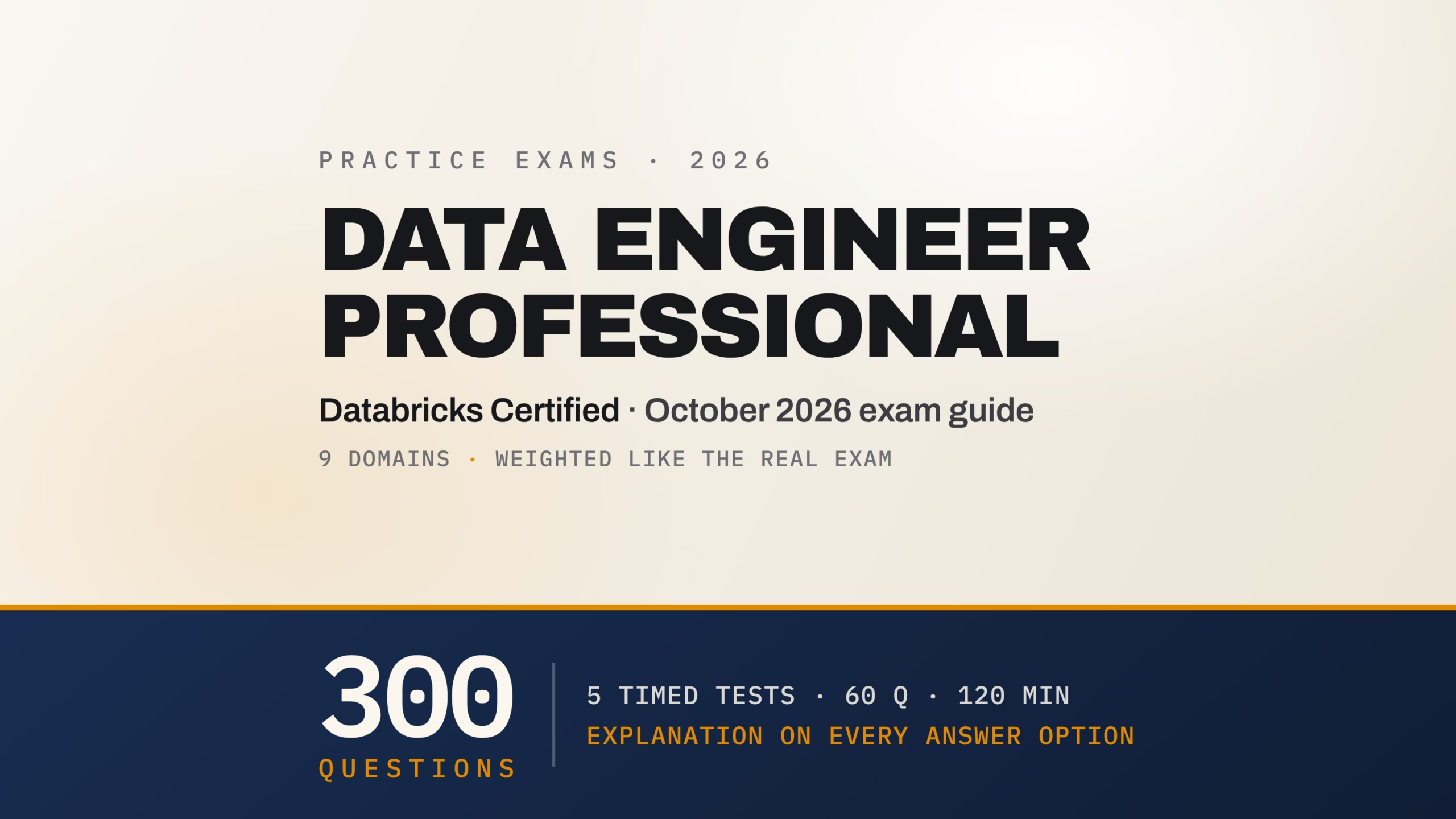
Databricks Data Engineer Professional: 5 Practice Tests
5 full-length tests, 295 questions, aligned with the July 2026 exam guide. An explanation for every answer option.
Are you ready to sit the Databricks Certified Data Engineer Professional exam? This course answers that question with 300 exam-style questions across five full-length practice tests, each one 60 questions long, exactly the number of scored questions on the real exam.
Every question is built on the official exam guide dated 9 October 2026 and its nine sections, using the weightings Databricks publishes: Developing Code for Data Processing using Python and SQL, Data Ingestion and Acquisition, Data Manipulation, Monitoring and Alerting, Cost and Performance Optimization, Ensuring Data Security and Compliance, Data Governance, Debugging and Deploying, and Data Modeling. Because every test uses the same distribution, your per-domain score report is comparable across attempts.
That currency matters more for this exam than for most. It was restructured from six sections to ten in September 2025, and again on 9 October 2026: nine sections, 60 scored questions, Data Sharing and Federation folded into Data Ingestion and Acquisition, and Data Transformation renamed Data Manipulation. That revision also brought in Iceberg, the VARIANT type, ABAC with governed tags, Unity Catalog metric views, Lakeflow Connect and Clean Rooms. Practice material written for an older structure drills sections that no longer exist and skips all of that. This course uses the terminology of the current guide: Lakeflow Pipelines, Lakeflow Jobs, AUTO CDC, Declarative Automation Bundles and Databricks Git folders.
The five tests get harder in a deliberate order. Test 1 is groundwork, one concept per question. Test 2 puts you in short practical situations. Test 3 is the hard one: two answers are defensible and a single constraint decides. Test 4 goes down to parameter names, SQL syntax and CLI commands. Test 5 is a full simulation with the longest scenarios and the real 120-minute clock.
Every answer option carries its own feedback saying why it is right or wrong and what the wrong option actually is, plus an overall explanation with a link to the official documentation. Tests 1 to 4 require 80 percent to pass and test 5 requires 85 percent, above the real exam, because practising at home is milder than sitting in a test centre.
This is a question bank with explanations, not a video course. It will find your weak sections and explain the answers. Pair it with the free Databricks Academy material and hands-on work in Databricks Free Edition.
Groundwork: Core Concepts and Platform Fundamentals
60 questions · 110 minutes · pass mark 80%
Start here, and take this test cold before you study. It covers the vocabulary the exam assumes you already own: streaming tables and materialized views, Auto Loader and Lakeflow Connect, AUTO CDC, Lakeflow Jobs and Declarative Automation Bundles, Unity Catalog objects and privilege inheritance, deletion vectors, liquid clustering, the VARIANT type, ABAC with governed tags, metric views, Change Data Feed, data skipping, system tables, the pipeline event log and the query profile. One idea per question and short stems, so a wrong answer points at a specific gap rather than at a long scenario you misread. All 60 questions are single-answer multiple choice, matching the real exam format, and the domain mix matches the official weightings, so your score report tells you which of the nine sections to study first. The pass mark is 80 percent, higher than the real exam, because recognising a term in a quiet room at home is easier than choosing between two plausible answers under a proctor.
In Practice: Pipelines, Ingestion and Governance at Work
60 questions · 115 minutes · pass mark 80%
Every question puts you in a short, concrete situation: a pipeline that must stay append-only, a recipient who needs an activation link, a job that should rerun only its failed tasks, a column that must be hashed before it reaches the silver layer. The skill being tested is telling neighbouring features apart - Auto Loader against COPY INTO, streaming tables against materialized views, expectations that drop records against a quarantine table, row filters against column masks, optimized writes against auto compaction. 60 single-answer questions, the same nine-domain mix as the real exam, 115 minutes, 80 percent to pass. Answer explanations name what each wrong option actually does, so the distractors teach you as much as the key does.
Trade-offs: When Two Answers Look Right
60 questions · 110 minutes · pass mark 80%
This is the test that separates people who have read the documentation from people who have run production workloads. In every question two answers are defensible and one constraint in the stem decides: latency, cost per run, whether the source emits updates and deletes, whether data may leave the environment, how many teams maintain the code, whether an external call is idempotent. Lakeflow Pipelines or Structured Streaming. Automatic clustering or keys you pick yourself. VARIANT or a fixed schema. A managed connector or a CDC pipeline you build. Repair run or full rerun. Each explanation states which constraint decided the question and when the runner-up would have been the right call - which is the reasoning the real exam rewards. 60 questions, 110 minutes, 80 percent to pass.
Under the Hood: Syntax, Parameters and APIs
60 questions · 95 minutes · pass mark 80%
Names and values, not concepts. cloudFiles.schemaLocation and the schemaEvolutionMode values. AUTO CDC with keys, sequence_by, apply_as_deletes and stored_as_scd_type. CLUSTER BY and CLUSTER BY AUTO, ALTER CATALOG ENABLE PREDICTIVE OPTIMIZATION, delta.enableChangeDataFeed, OPTIMIZE with ZORDER BY, REORG TABLE APPLY PURGE before VACUUM. CREATE POLICY with MATCH COLUMNS, parse_json and the colon accessor, CREATE VIEW WITH METRICS LANGUAGE YAML, USING iceberg. GRANT with USE CATALOG and USE SCHEMA, SHOW GRANTS, information_schema. databricks bundle validate, deploy, run and destroy, and what development mode does that production mode does not. The stems are short and the options differ in one detail, so the clock is tighter than in the other tests: 95 minutes for 60 questions. 80 percent to pass. Every parameter and function name in this test was checked against the current Databricks documentation.
Exam Day: Full-Length Simulation
60 questions · 120 minutes · pass mark 85%
Save this one. Sit it in a single uninterrupted session, with the same 60 questions and the same 120 minutes as the real exam, and treat the result as your readiness verdict. The stems are the longest in the course and each carries at least two constraints - an SLA and a budget, a retention policy and a query pattern, an existing architecture and a governance rule - with the nine domains shuffled together the way they arrive on the day. Topics run from diagnosing a cost spike in system tables to right-to-be-forgotten across bronze, silver and gold including time travel, from skewed joins to drift between Git and a deployed bundle. The pass mark is 85 percent rather than 80, because the last rehearsal should be harder than the performance; clearing it at home leaves you margin in the test centre.
What you will practice
- Test yourself against 295 exam-style questions covering all ten sections of the July 2026 Databricks Data Engineer Professional exam guide.
- Tell neighbouring features apart: streaming tables vs materialized views, Auto Loader vs COPY INTO, liquid clustering vs partitioning vs ZORDER.
- Read every answer option and learn why it is right or wrong, with a link to the official Databricks documentation on every question.
- Work up from single-concept questions to a full-length 59-question simulation under the real 120-minute exam clock.
- Use the per-domain score report after each attempt to find which of the ten exam sections still needs your study time.
- Practise the reasoning the exam rewards: two defensible options, one constraint in the question that decides which one wins.
- Recognise current Lakeflow terminology - Declarative Pipelines, Lakeflow Jobs, AUTO CDC, Declarative Automation Bundles, Git folders.
Exam domains covered
Who is this for
Data engineers who already build pipelines on Databricks and want to know whether they are ready to sit the Professional exam. Platform and analytics engineers who maintain Lakeflow Jobs, Spark Declarative Pipelines and Unity Catalog in production and want their gaps mapped before paying the exam fee. Data engineers who hold the Data Engineer Associate certification and are stepping up to the Professional level, which is a considerably deeper exam, with far more weight on cost and performance optimization, security and compliance, and CI/CD with Declarative Automation Bundles. Cloud and analytics architects who need Databricks depth beyond their own specialism. Anyone who studied for this exam before October 9, 2026 should also take note: the exam guide was restructured into nine sections on that date, so older practice material may prepare you for a structure that no longer exists. This practice set is a question bank with detailed explanations. It will find your gaps and explain the answers; it will not teach you Databricks from scratch.
Requirements
- No prior certification is required. You need working knowledge of SQL and Python, and some hands-on time in a Databricks workspace.
- Familiarity with Spark DataFrames, Delta Lake tables and the basics of Unity Catalog. Databricks Free Edition is enough to practise on.
- These are practice exams, not a course. Use them next to the free official Databricks Academy material and the product documentation, not instead of them.
Free exam guide
Not sure what to expect? Read how the exam is built, what it covers and how to prepare.