
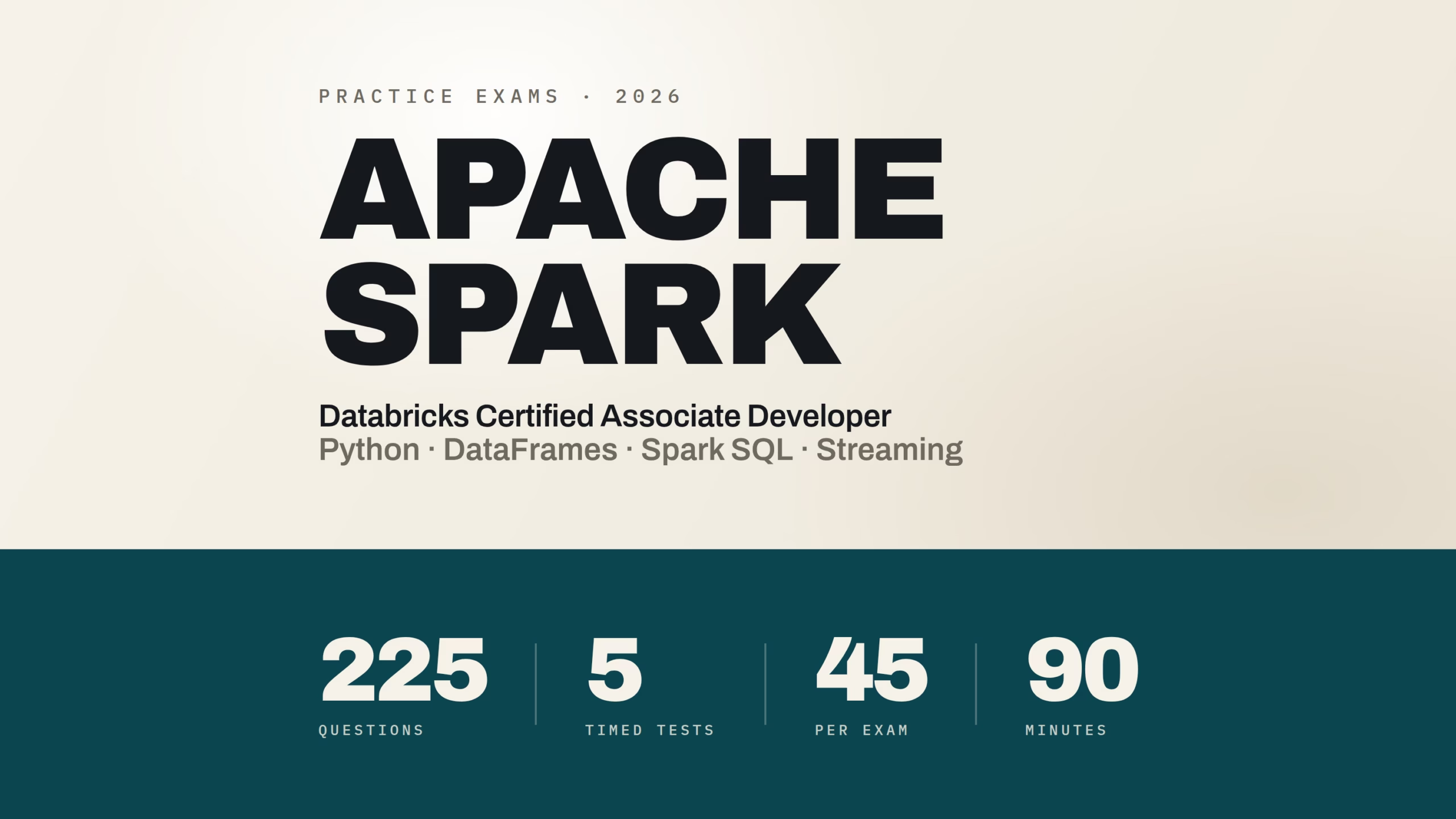
Apache Spark Developer Associate: 5 Practice Exams
Unofficial practice exams: Spark architecture, Spark SQL, DataFrame API, Structured Streaming. 225 explained questions.
The only question that matters the week before your exam is whether you are ready, and a question bank that tells you "83 percent" without telling you where you lost the other 17 is not an answer. Every test in this practice set reports your score by exam domain, against the seven sections of the official exam guide, so you always know what to revise next.
There are 225 original questions across five full-length practice exams, built to the exam guide Databricks last updated on 8 October 2026 and weighted close to Databricks' published weighting: Apache Spark Architecture and Components 20 percent, Using Spark SQL 20 percent, Developing DataFrame and DataSet API Applications 30 percent, Troubleshooting and Tuning 10 percent, Structured Streaming 10 percent, Spark Connect 5 percent, pandas API on Spark 5 percent. All code is Python, because the exam is Python only.
If you have looked at practice material for this certification before, read this paragraph. The exam that most of the material online prepares for no longer exists. The retired Spark 3.0 exam was 60 questions in 120 minutes, was offered in Python and Scala, and put around 72 percent of its weight on the DataFrame API. The current exam is 45 questions in 90 minutes, Python only, and examines four subject areas the 3.0 exam never touched: Structured Streaming, Spark Connect, the pandas API on Spark, and troubleshooting and tuning as a domain in its own right. Preparing on 60-question tests that never mention watermarks, output modes or gRPC will leave you short on a fifth of the paper.
The five tests climb deliberately. Test 1, Groundwork, is a cold baseline of short, direct questions. Test 2, In Practice, gives you realistic snippets and asks you to separate calls that look interchangeable. Test 3, Trade-offs, gives you two defensible answers and one constraint in the scenario that decides between them. Test 4, Under the Hood, is about exact defaults, signatures and accepted parameter strings. Test 5, Exam Day, matches the real exam on length and clock and mixes domains inside single long scenarios.
Every answer option carries its own explanation, not just the right one, and each wrong option says what it actually is, so the distinction sticks. On top of that each question has a full rationale of a few hundred words ending with a link to the Apache Spark or Databricks documentation page that supports it. Where a fact changed between Spark releases, or where the documentation contradicts the runtime, that topic was deliberately left out rather than keyed to a value that might be wrong on your exam day.
The pass mark is set at 80 percent for the first four tests and 85 percent for the simulation. Databricks does not publish its passing score – it is set by statistical analysis and can change – so a scaled result cannot be converted into a percentage, and the only safe target is one comfortably above any plausible cut.
What this is not: a video course, a lab environment, or real exam questions. Every question here was written from the published objectives. This practice set is not affiliated with, endorsed by or sponsored by Databricks or the Apache Software Foundation. Apache Spark is a trademark of the Apache Software Foundation.
Groundwork: Architecture, DataFrames and Spark SQL
45 questions · 115 minutes · pass mark 80%
Start here, cold, before you study anything. This test covers the seven exam domains at their foundation: what the driver, executors and cluster manager each do, how jobs break into stages and tasks, the difference between a transformation and an action, the DataFrame operations you will use every day, temporary views and save modes, the streaming programming model, deployment modes, and the pandas API on Spark. Questions are short and direct, one idea each, so your score tells you exactly where the gaps are. The pass mark is 80 percent rather than the real exam's mark, on purpose: you want comfortable headroom, not a coin flip on the day. Read every explanation, including on the questions you got right.
In Practice: Everyday PySpark Pipelines
45 questions · 110 minutes · pass mark 80%
Short, realistic scenarios and small PySpark snippets. The recurring theme is telling apart two calls that look interchangeable and are not: union against unionByName, distinct against dropDuplicates, coalesce against repartition, filter pushdown against a bounds-based JDBC read, take against limit. Each question still turns on a single idea, but you now have to read a code block and predict what Spark actually does with it. All code is Python, exactly as on the real exam. Pass mark 80 percent, 110 minutes for 45 questions - slightly more air than the real thing.
Trade-offs: The Right Call Under Real Constraints
45 questions · 105 minutes · pass mark 80%
Every question here has two defensible answers, and one constraint stated in the scenario decides between them: memory that the data does not fit into, a latency target, an accuracy tolerance, a determinism requirement, state that grows without bound, a cluster that is already busy. Miss the constraint and you will pick an answer that is reasonable in general and wrong here. This is the skill the real exam tests hardest, and the one that plain flashcards never build. Two pairs of questions are deliberately near-identical with one detail changed, so read each scenario to the end. Pass mark 80 percent, 105 minutes for 45 questions.
Under the Hood: Defaults, Signatures and Behaviour
45 questions · 100 minutes · pass mark 80%
The precision test. Exact configuration keys and their default values, the strings that a parameter actually accepts, which methods only work in combination with which others, how many rows a call emits, what a snippet prints or raises. Shuffle partitions, the broadcast threshold, the unified memory regions, JDBC partitioning options, CSV parse modes, join type strings, the pandas-on-Spark index types, streaming sinks and their guarantees. Every value keyed in this test was verified against Apache Spark documentation and source rather than repeated from another course, and topics whose default changed between Spark releases were deliberately left out. Pass mark 80 percent, 100 minutes for 45 questions.
Exam Day: Full-Length Timed Simulation
45 questions · 90 minutes · pass mark 85%
Take this one in a single uninterrupted sitting, with no notes, as your readiness gate. It matches the real exam exactly on length and clock: 45 questions in 90 minutes, two minutes per question. The scenarios are the longest in this practice set, they carry several constraints at once, and they mix domains inside a single question the way the real exam does. Many are diagnostic: something has gone wrong, and the fix that addresses the symptom is on the list next to the one that addresses the cause. The pass mark is raised to 85 percent because Databricks does not publish its passing score and sets it statistically, so the only safe target is one comfortably above any plausible cut. Clear 85 here and you are ready to book.
What you will practice
- Test yourself against 225 original questions covering all seven domains of the current exam, weighted exactly as the official exam guide weights them.
- Tell apart the Spark APIs that are easiest to confuse, such as union and unionByName, coalesce and repartition, distinct and dropDuplicates.
- Recall the configuration defaults, accepted parameter strings and method signatures that the exam asks about directly.
- Read every answer option with its own explanation, right or wrong, plus a full rationale linked to the official documentation.
- Work up a deliberate difficulty curve from plain recall to multi-constraint scenarios, ending in a full-length timed simulation.
- See your score broken down by exam domain after every attempt, so revision goes where the gap is.
- Practise Structured Streaming, Spark Connect and the pandas API on Spark, the three areas the older courses do not cover.
Exam domains covered
Who is this for
Data engineers, analytics engineers, software developers and platform engineers who already write PySpark and now want the certificate to prove it. Analysts and data scientists moving from pandas into Spark, who will recognise the pandas API on Spark material as the bridge they have been standing on. Students and career changers targeting a first data-engineering role, for whom an associate-level Databricks certificate is a concrete, checkable credential. Consultants and contractors who need a current Spark certification on a bid.
Read this part carefully if you have studied before. This exam replaced the retired Databricks Certified Associate Developer for Apache Spark 3.0, whose registration closed in 2025. The old exam was 60 questions in 120 minutes, could be taken in Python or Scala, and devoted roughly 72 percent of its questions to the DataFrame API with the rest split across two architecture sections. The current exam is 45 questions in 90 minutes, Python only, and spreads across seven sections: Spark SQL is now a domain of its own at 20 percent, and Troubleshooting and Tuning, Structured Streaming, Spark Connect and the pandas API on Spark are all examinable and did not exist on the 3.0 exam at all. Much of the practice material still circulating online, including some of the most popular courses, is built on the old blueprint. If you are preparing on 60-question tests that never mention watermarks or Spark Connect, you are preparing for an exam that no longer exists.
What this practice set is: five full-length practice exams with a written explanation for every option. What it is not: a video course, a lab environment, a set of real exam questions, or a guarantee. Every question here was written from the published exam objectives. Nobody can promise you a pass; what this can do is show you, domain by domain, whether you are ready to book.
Requirements
- Basic Python. All code in this practice set is PySpark, because the exam is Python-only; no Scala is required or used.
- Some hands-on Spark or Databricks experience helps a great deal. Databricks recommends roughly six months of it, but you can start these tests earlier and use your domain scores to steer your study.
- This is a question bank, not a course. It is designed to sit alongside the free official material - the Databricks exam guide, the Databricks Academy self-paced Apache Spark pathway and the Apache Spark documentation - not to replace them.
Free exam guide
Not sure what to expect? Read how the exam is built, what it covers and how to prepare.