
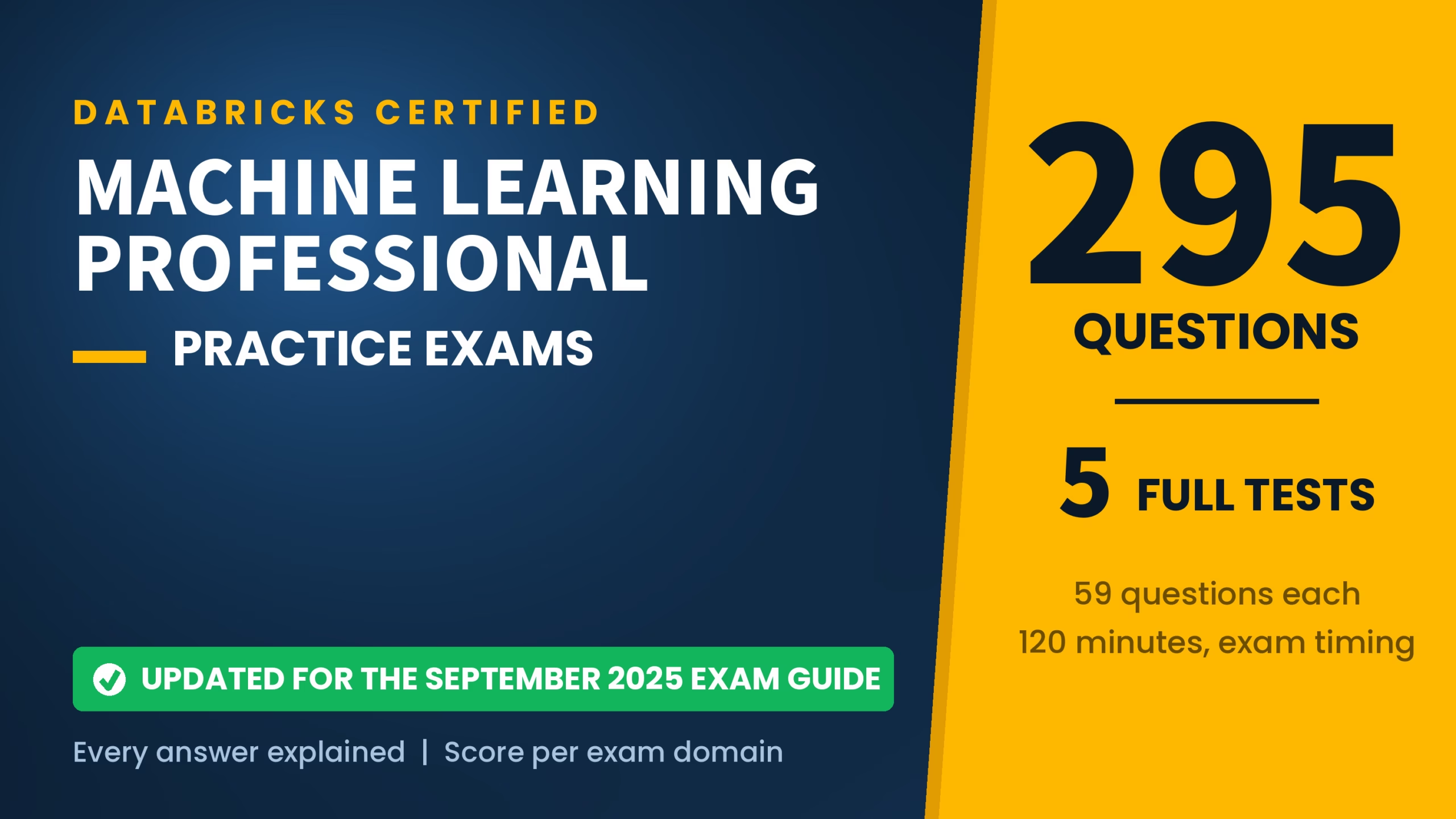
Databricks ML Professional: 5 Practice Tests 2026
Model Development, MLOps and Model Deployment: 295 exam-weighted questions with explained answers and sources
Are you actually ready to sit the Databricks Certified Machine Learning Professional exam? That is the only question these five practice tests are built to answer, and they answer it with evidence rather than a feeling.
You get 295 questions, written against the current exam guide covering the skills measured as of September 2025, and weighted exactly as the real exam is weighted: 44% Model Development, 44% MLOps, 12% Model Deployment. Every test carries 59 questions, the same number the real exam scores.
If you prepared for this exam earlier, note what changed. Until 30 September 2025 the exam was organised around Experimentation, Model Lifecycle Management, Model Deployment, and Solution and Data Monitoring. The current version expects distributed training and tuning with the pandas Function API, Optuna and Ray, advanced Feature Engineering including point-in-time correctness and on-demand features, Databricks Asset Bundles, automated retraining, drift detection with Lakehouse Monitoring, and custom PyFunc models on Databricks Model Serving. Older question banks still test model registry stages and registry webhooks, neither of which applies to models in Unity Catalog. Practising against the wrong exam is worse than not practising.
The five tests rise in difficulty while keeping the same shape. Test 1, Groundwork, asks direct single-concept questions and gives you a clean baseline. Test 2, In Practice, puts you in short scenarios that separate services people confuse. Test 3, Trade-offs, gives you two defensible options and one constraint that decides between them. Test 4, Under the Hood, tests the implementation detail: arguments, commands, metric table columns and serving configuration. Test 5, Exam Day, is a full 59-question simulation in 120 minutes with mixed domains and long stems.
Every answer option has its own explanation saying why it is right or, when it is wrong, what that option actually does. Each question then closes with an overall explanation of 400 to 650 characters and a link to the official Databricks or MLflow documentation, so you can go straight to the source. After each attempt you get a score per domain, which tells you where to revise.
The pass mark is set at 80% for tests 1 to 4 and 85% for test 5, above what the real exam requires. Databricks does not publish a passing score for the Databricks Certified Machine Learning Professional exam, and scaled scores are not percentages, so a deliberate margin is the honest way to judge readiness.
These tests will not teach you Databricks. Use them alongside the official Databricks Academy training and the documentation, and use the explanations to find the gaps. None of these questions are real exam questions.
Groundwork: Core Databricks ML Concepts
59 questions · 140 minutes · pass mark 80%
Description: Start here with a cold, untimed-feeling run that establishes your baseline. This test covers the fundamentals the exam assumes you already own: Spark ML pipelines, estimators and transformers, evaluators, pandas function APIs, MLflow tracking and signatures, the Feature Engineering client, Unity Catalog model aliases, Databricks Asset Bundles, job triggers, data profiling monitors and the difference between blue-green and canary rollouts. Questions are direct and each one tests a single idea, so a wrong answer points at exactly one gap. All 59 questions follow the official domain weighting: 26 on Model Development, 26 on MLOps, 7 on Model Deployment. The pass mark here is 80%, deliberately higher than what you need on exam day, because these are the concepts every later question builds on. Read every explanation, including the ones you answered correctly.
In Practice: Applying the Databricks ML Stack
59 questions · 135 minutes · pass mark 80%
Description: Short practical scenarios that ask you to pick the right tool from a set of neighbours that are easy to confuse: applyInPandas against mapInPandas, FeatureLookup against FeatureFunction, Optuna against Ray Tune, aliases against version pins, a scheduled trigger against a file arrival trigger, a Kolmogorov-Smirnov test against a chi-squared test. Every question puts you in a situation and asks what you would actually do. The domain split matches the exam exactly: 26 Model Development, 26 MLOps, 7 Model Deployment, 59 questions in 135 minutes. Each answer option carries its own feedback telling you what that option really does, so the distinctions stick rather than being memorised. Take this test after you have worked through the explanations from test 1.
Trade-offs: Choosing the Right Approach
59 questions · 130 minutes · pass mark 80%
The exam rarely asks which option works; it asks which option is right given a constraint. In this test two answers are usually defensible and a single detail decides: data that will not fit on one machine, a production catalog that cannot be copied, labels that arrive ninety days late, a latency budget, a cost ceiling, a regulated segment, a lookback window. You will weigh deploy code against deploy models, scale-up against scale-out, batch against real-time, baseline drift against consecutive drift, offline evaluation against a live canary. 59 questions in 130 minutes, weighted 26 / 26 / 7 across Model Development, MLOps and Model Deployment. Expect to slow down here. The explanations state the deciding constraint explicitly so you learn to spot it in the question stem.
Under the Hood: APIs, Parameters and Limits
59 questions · 125 minutes · pass mark 80%
Implementation detail, at the level the exam actually tests it. Arguments of create_table, create_training_set, FeatureLookup and FeatureFunction; what changed in MLflow 3 for log_model and model URIs; step-wise metric logging and table artifacts; Optuna study direction and distributed studies; bundle resource types, keys, includes, targets and the validate-deploy-run order; job notifications, retries and trigger prerequisites; evaluation model types, custom metrics and validation thresholds; the exact columns of the profile and drift metric tables; served entities, workload types and traffic routes. 59 questions in 125 minutes, weighted 26 / 26 / 7. This is the test that turns "you know the concept" into "you know the call". Every explanation links to the official documentation page for the detail in question.
Exam Day: Full-Length Timed Simulation
59 questions · 120 minutes · pass mark 85%
A full simulation under real conditions: 59 questions in 120 minutes, exactly the length and timing of the real exam, with the official 44 / 44 / 12 domain weighting. Stems are long, several constraints appear in one question and the domains are mixed, so you have to identify what is being asked before you can answer it. Sit this one in a single uninterrupted session, with no notes, and treat the clock as real. The pass mark is 85%, higher than the other tests and far above what you would need on the day, because a comfortable margin here is what makes a pass under exam pressure predictable. Use the per-domain breakdown afterwards to decide where to revise, then leave a few days and sit it again.
What you will practice
- Sit five full-length, exam-weighted practice tests for the Databricks ML Professional exam, updated to the September 2025 exam guide.
- Test yourself on Model Development, MLOps and Model Deployment at the official 44 / 44 / 12 weighting, with per-domain scoring per attempt.
- Tell apart the concepts the exam confuses: applyInPandas and mapInPandas, FeatureLookup and FeatureFunction, aliases and stages.
- Learn why every option is right or wrong from per-answer feedback and an overall explanation linking to the official documentation.
- Build up from single-concept questions to a timed 59-question simulation matching the real exam in length, weighting and difficulty.
- Practise the detail the exam tests: client arguments, MLflow 3 changes, bundle commands, monitor metric tables and serving settings.
- Identify the deciding constraint in a scenario question, which is what separates a defensible answer from a merely plausible one.
Exam domains covered
Who is this for
Machine learning engineers, data scientists and data engineers who are preparing for the Databricks Certified Machine Learning Professional exam and want to know whether they are ready before they pay to sit it. It suits practitioners who already build models on Databricks and now need to be sure they can answer questions about Unity Catalog model lifecycle management, Databricks Asset Bundles, automated retraining, data profiling monitors and custom model serving under time pressure. It also suits engineers moving from a general MLOps background into Databricks specifically, and Databricks Certified Machine Learning Associate holders taking the next step.
Read this if you studied for this exam before autumn 2025. The exam changed on 30 September 2025. The previous version was organised around Experimentation, Model Lifecycle Management, Model Deployment, and Solution and Data Monitoring. The current version is organised around Model Development, MLOps and Model Deployment, and it has moved substantially towards enterprise-scale operations: distributed tuning with Optuna and Ray, the pandas Function API, point-in-time correctness and on-demand features, Databricks Asset Bundles, automated retraining, Lakehouse Monitoring (now documented as data profiling) and custom model serving. Older practice material still tests workspace model registry stages and registry webhooks, which no longer reflect how models in Unity Catalog work. Every question in this practice set is written against the current exam guide.
What this is: 295 questions with a detailed explanation for every answer option and a link to the official documentation, so a wrong answer teaches you something. What this is not: a substitute for the official training, for the documentation, or for hands-on work in a Databricks workspace. No practice test can make you competent at a platform, and none of these questions are real exam questions.
Requirements
- Working knowledge of Python and of machine learning libraries such as scikit-learn, SparkML and MLflow. You do not need to be an expert, but you should be able to read a code-level question without looking up basic syntax.
- Some hands-on exposure to Databricks: notebooks, Unity Catalog, jobs and MLflow tracking. Databricks recommends around a year of practical experience for this exam.
- These are practice tests, not a course. They are designed to sit alongside the free official Databricks Academy learning paths and the product documentation, and to tell you where to go back and study. They do not teach the platform from scratch.
Free exam guide
Not sure what to expect? Read how the exam is built, what it covers and how to prepare.