
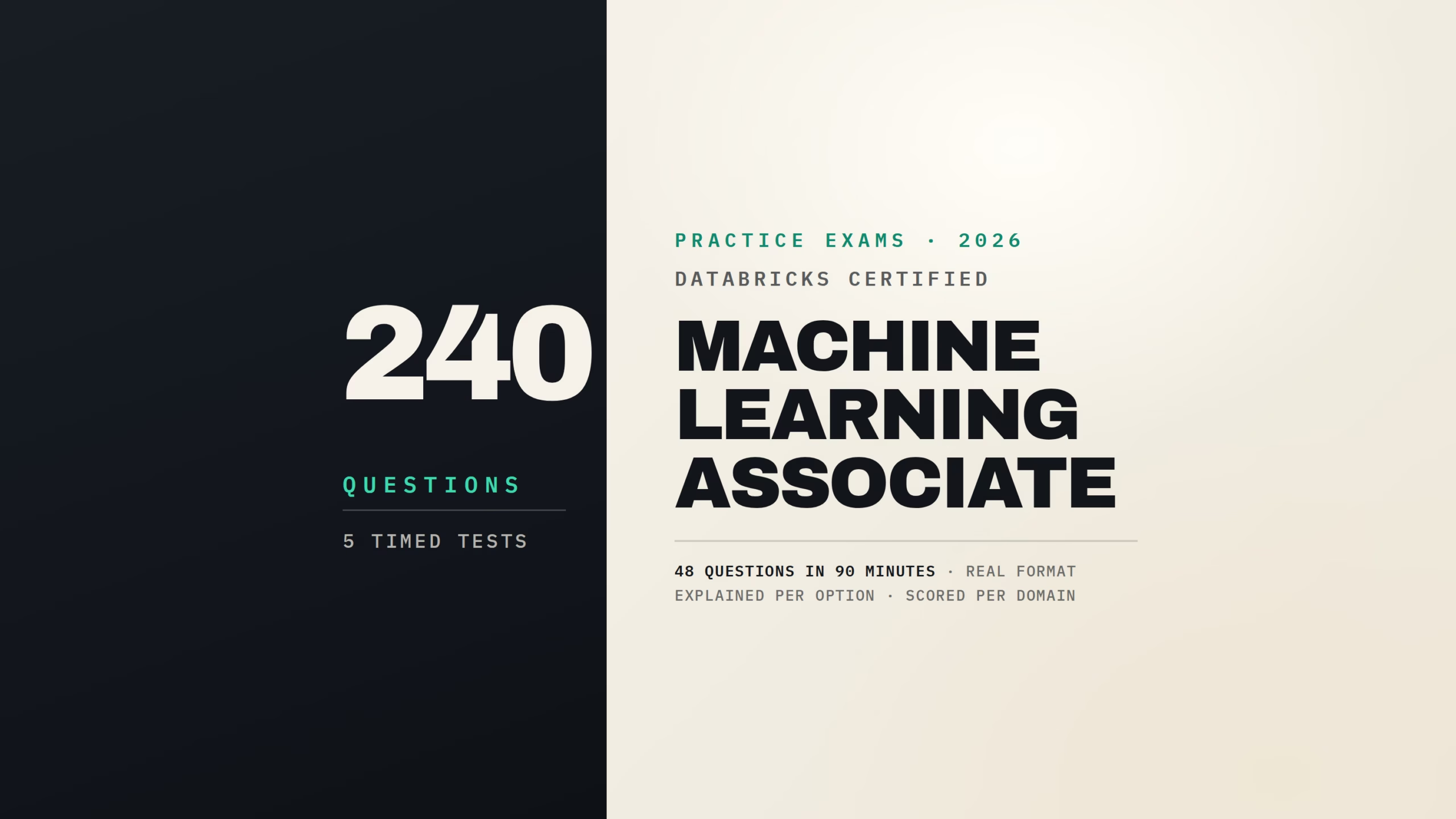
Databricks ML Associate: 5 Practice Exams, 240 Q (2026)
Five 48-question exams in the real 90-minute format. Unity Catalog, MLflow, AutoML, Spark ML, model serving.
Can you pass the Databricks Certified Machine Learning Associate exam today? Not "do you know Databricks" – can you sit 48 questions in 90 minutes, under someone else's clock, and clear a cut score Databricks does not publish? That is a different question, and this practice set is built to answer it.
Five practice exams, 48 questions each, 240 questions in total. Every test matches the real exam's length and timing and follows the four sections of the exam guide that is live as of 1 March 2025: Databricks Machine Learning, Data Processing, Model Development and Model Deployment. Because each test uses the same section weighting, your per-section score is comparable from one attempt to the next, and you can see a weak area shrink instead of guessing.
If you have been studying from older material, check the date on it. The Databricks ML Associate exam went from 45 questions to 48 in October 2024 and gained multiple-selection questions. The outline was then rewritten in March 2025: the old section devoted to Spark ML is gone, feature tables and the model registry are Unity Catalog objects, and models are promoted with aliases rather than the old workspace stages. Practice tests written against the previous outline will train you for an exam that no longer exists.
The five tests build. Test 1 is a cold baseline of short, direct questions. Test 2 puts them into short scenarios and asks you to separate tools that sit next to each other. Test 3 gives you two defensible answers and one constraint that decides. Test 4 goes to parameters, method behaviour and arithmetic. Test 5 is a full simulation: longest stems, mixed sections, 90 minutes, one sitting.
Every answer option has its own feedback, so you find out why the option you picked was wrong and what it actually does. Every question closes with an overall explanation and a link to the Databricks, MLflow or Spark documentation page it came from. The pass mark is set at 80% on tests 1 to 4 and 85% on test 5, deliberately above what you need on the day.
What this is not: it is not a course, and it is not a collection. There are no real exam questions here. Use it alongside the free Databricks Academy self-paced courses and a workspace you can break.
Groundwork: Core Databricks ML Concepts
48 questions · 110 minutes · pass mark 80%
Start here, and take it cold. This first test is a baseline, not a rehearsal: it tells you which of the four exam sections you already own and which one you have been avoiding. The 48 questions match the length of the real exam and follow the same four sections, but each one asks about a single idea in a short, direct stem - what an ML runtime gives you, what a feature table needs, what an alias points at, what RMSE is measured in. Nothing here hides behind a scenario. The passing mark is set at 80%, higher than you need on the day, because a comfortable pass on straightforward questions is the only sane starting point for the four harder tests that follow. You get 110 minutes, so time pressure is not the test here; accuracy is. When you are done, read every explanation, including the ones you got right, and note the section where your score dipped.
In Practice: Feature Tables, MLflow and Pipelines
48 questions · 105 minutes · pass mark 80%
Test 2 moves from definitions to situations. Every question is a short scenario, and most of them turn on telling apart two things that sit next to each other in the platform and are easy to blur: an offline feature table and an online store, a parameter and an artifact, an estimator and a transformer, merge and overwrite, a metric that flatters an imbalanced dataset and one that does not. The four sections keep the same weight as the real exam, so your per-section report stays comparable to test 1. Seven questions have more than one correct answer and say so. The pass mark stays at 80% and the clock comes down to 105 minutes. If you passed test 1 but not this one, the gap is not knowledge - it is knowing which of two familiar tools the situation is actually asking for.
Trade-offs: When Two Answers Look Right
48 questions · 100 minutes · pass mark 80%
This is the test where two options are both defensible and one constraint in the stem decides. A batch job or a real-time endpoint depends on the latency the business asked for. Cross-validation or a single split depends on how much data and how much compute you have. Promoting code or promoting a model depends on whether you retrain on production data. Registering in Unity Catalog or leaving a model in the workspace depends on who needs to read it. Read the stem twice: the deciding detail is usually one clause long and easy to skim past. Sections keep the real exam's weighting, seven questions take more than one answer, the pass mark is 80% and you have 100 minutes. Expect your score to drop here compared with test 2. That is what this test is for.
Under the Hood: Parameters, Methods and Counts
48 questions · 95 minutes · pass mark 80%
Test 4 is the implementation level. The questions are short again, but they want specifics: which argument a cross-validator needs, what happens to rows that are not in a merge batch, what a scoring call expects in its input, which order an indexer and an encoder run in, what a traffic split has to add up to, and how many models a grid search with folds actually trains. There is arithmetic here, and you are expected to do it in your head. Eight questions take more than one answer. The four sections keep the same weight as the real exam, the pass mark stays at 80%, and the clock tightens to 95 minutes. If the earlier tests found the gaps in your judgement, this one finds the gaps in your hands-on time.
Exam Day: Full-Length Simulation
48 questions · 90 minutes · pass mark 85%
Treat this one as the real thing. 48 questions, 90 minutes on the clock - the exact length and timing of the Databricks Certified Machine Learning Associate exam - in one uninterrupted sitting, no notes, no pausing. The stems are the longest of the five tests, several carry more than one constraint, and sections are deliberately mixed inside a single scenario, so a deployment question may still make you reason about a metric or a feature lookup. Eight questions take more than one answer. The pass mark is 85%, the highest of the five and higher than anything Databricks asks of you, because passing at home under mild conditions should mean more than scraping through in a proctored session. Save this test until you have worked through the explanations of the first four. If you clear it twice on different days, you are ready to book.
What you will practice
- Sit five full-length practice exams in the real 48-question, 90-minute format of the Databricks ML Associate exam.
- Judge your readiness section by section: Databricks Machine Learning, Data Processing, Model Development and Model Deployment.
- Work with feature tables in Unity Catalog, MLflow tracking, model registration, aliases and model serving endpoints.
- Read a scenario and pick the metric, the validation strategy and the serving approach the constraints actually call for.
- Learn from every answer you give: each option carries its own feedback, right or wrong, plus a documentation link.
- Build up from short knowledge questions to a timed full simulation, so exam day is not the first time you feel the clock.
Exam domains covered
Who is this for
Data scientists and machine learning engineers who already build models and now want the Databricks credential to prove it. Data engineers and analytics engineers moving into ML work who know Spark and Delta but have not yet worked with MLflow, feature tables in Unity Catalog or model serving. Students and career changers with a solid grounding in machine learning theory who need to translate it into the Databricks platform. Consultants and solution architects who have to speak credibly about MLOps on Databricks in front of a client.
One thing to check before you buy. The exam changed on 28 October 2024: it went from 45 questions to 48, and multiple-selection questions were added. The exam guide was then rewritten on 1 March 2025, dropping the old outline that had a separate Spark ML section worth roughly a third of the exam, and putting Unity Catalog at the centre of the feature store and the model registry. A lot of practice material still on sale was written against the older outline. These tests are written against the guide that is live as of 1 March 2025.
This is a question bank with explanations. It will show you what you do not know and teach you the distinctions the exam cares about, but it is not a substitute for the Databricks Academy courses or for time spent in a workspace. There are no real exam questions here, and nobody who sells you those is doing you a favour.
Requirements
- No prior certification is required, and there are no formal entry requirements for the exam itself.
- You should be able to read Python and basic PySpark. The exam assumes you have written training code, not just read about it; Databricks recommends around six months of hands-on work with the platform.
- These are practice exams, not a course. They are built to sit alongside the free Databricks Academy self-paced courses and the official exam guide, not to replace them. Bring a Databricks workspace you can experiment in.
Free exam guide
Not sure what to expect? Read how the exam is built, what it covers and how to prepare.