
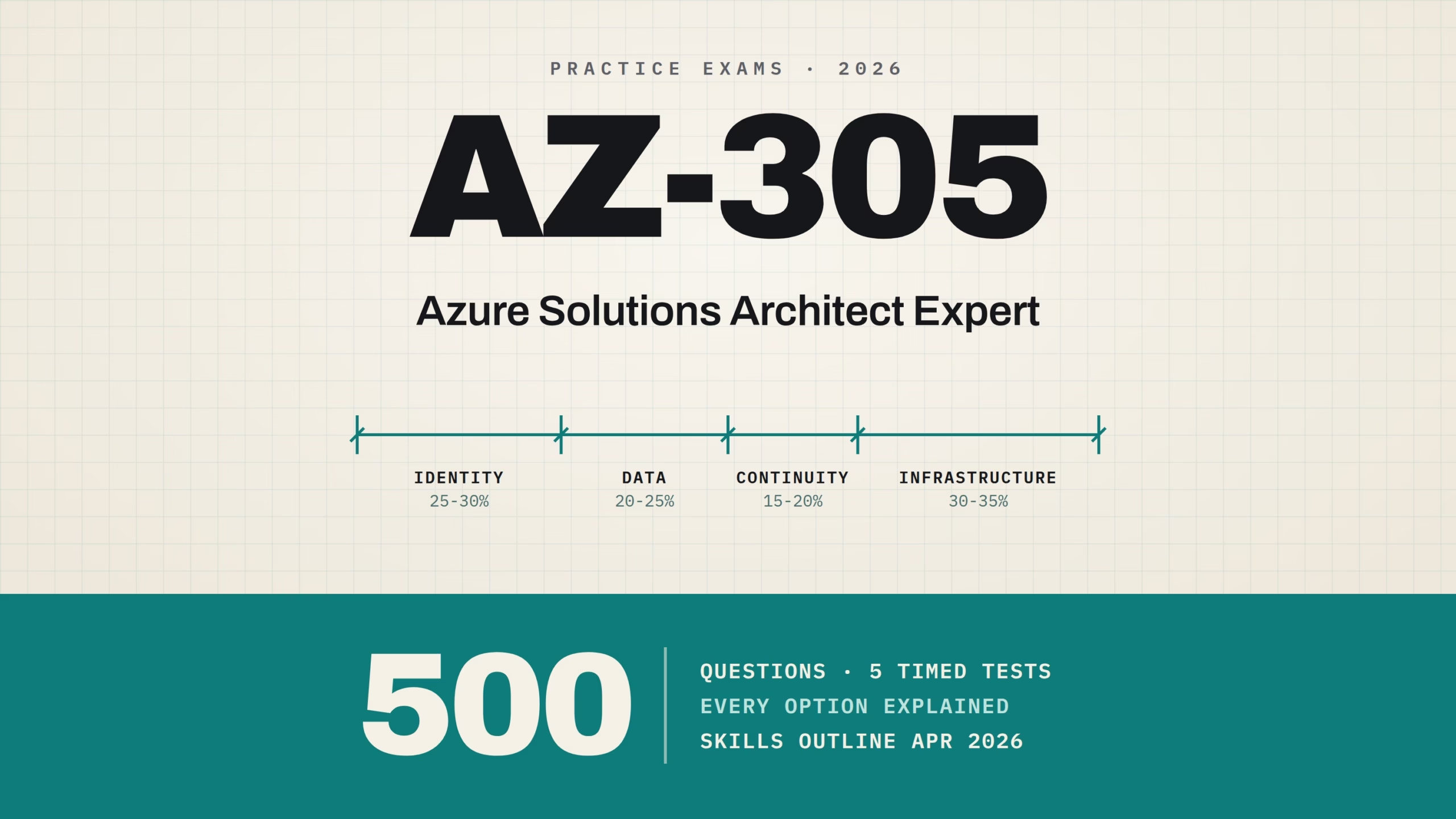
AZ-305 Azure Solutions Architect Expert: 5 Practice Tests
500 original questions on identity, governance, data storage, business continuity and infrastructure design
Can you look at a set of business requirements and pick the one Azure design that meets all of them? That is what Exam AZ-305: Designing Microsoft Azure Infrastructure Solutions asks of you, and these practice tests tell you whether you are ready before you pay for an attempt.
This practice set contains 500 original questions in five practice tests of 100 questions each. They follow the AZ-305 skills outline dated April 17, 2026, and every test covers the four domains in the same proportions as the official weighting: design identity, governance, and monitoring solutions; design data storage solutions; design business continuity solutions; and design infrastructure solutions.
AZ-305 replaced the retired AZ-303 and AZ-304 exams in 2022 and focuses purely on design. Azure itself has moved on since much older study material was written: Microsoft Entra ID instead of Azure AD, Azure Monitor Agent instead of the legacy Log Analytics agent, Azure Managed Redis, Flex Consumption for Functions, Azure Update Manager. Practice questions built on retired products or old exam objectives prepare you for an exam that no longer exists. Retired services appear here only as wrong answers, and the explanation says why.
The five tests get harder in how the questions are asked, not in how obscure the facts are:
– Groundwork: one requirement, one concept, short stems.
- In Practice: short scenarios that separate services that are easily confused.
- Trade-offs: two defensible designs where cost, RPO/RTO, residency, latency or admin effort decides.
- Under the Hood: tiers, settings, required components and the order of steps.
- Exam Day: case-style scenarios with several requirements and mixed domains, under the tightest clock.
Every answer option has its own feedback. Wrong options explain what that service or setting is actually for, so the distinction sticks. Each question also has an overall explanation that links to the Microsoft Learn or Azure Architecture Center page it is based on, so you can verify every answer yourself.
After each attempt PrepKiwi shows your score per domain, so you know exactly where to go back to. The pass mark is 80% for tests 1 to 4 and 85% for the final simulation, higher than the real exam on purpose: practising at home is easier than sitting a proctored exam.
What this practice set is not: a video course, a hands-on lab or a collection of real exam questions. It tests and explains. Use it alongside the free official Microsoft Learn paths for AZ-305 and your own hands-on experience in Azure.
Groundwork: Core Azure Design Choices in All Four Domains
100 questions · 160 minutes · pass mark 80%
Your baseline. 100 direct questions that map one clear requirement to the right Azure service or design choice, spread across all four AZ-305 domains in the same proportions as the official skills outline (April 17, 2026): identity, governance and monitoring; data storage; business continuity; and infrastructure. Stems are short and test one concept each, including 12 multi-select questions. You have 160 minutes and need 80% to pass. That is deliberately higher than the real exam's scaled 700, because practising at home with no proctor is easier than sitting the real thing. Take this test cold before you study, then use the score per domain to decide where to start. Every answer option has its own explanation, and each question ends with a link to the Microsoft Learn page it is based on.
In Practice: Telling Neighbouring Azure Services Apart
100 questions · 160 minutes · pass mark 80%
Short practical scenarios in which the right answer sits next to a service that does almost the same thing: Event Grid or Service Bus, availability sets or zones, managed identity or service principal, private endpoint or service endpoint, Backup or Site Recovery. 100 questions, 14 of them multi-select, weighted across the four AZ-305 domains like the official outline. You have 160 minutes and need 80% to pass. Read the explanation on every option, including the ones you got right: the feedback on each wrong option says what that service is actually for, which is exactly the distinction this level trains.
Trade-offs: When Two Designs Both Look Right
100 questions · 160 minutes · pass mark 80%
Two designs both look defensible; one stated constraint decides. Cost, recovery point and recovery time objectives, data residency, latency, administrative effort or an on-premises dependency tips the balance in every question. This is the level where most AZ-305 candidates lose points, because the exam rewards the design that meets all requirements, not the one that is merely possible. 100 questions, 14 multi-select, 160 minutes, 80% to pass. When you miss one, find the requirement in the stem you overlooked before reading the explanation.
Under the Hood: Tiers, Settings and Order of Steps
100 questions · 140 minutes · pass mark 80%
The details that turn a design into a working one: which tier or SKU includes a capability, which setting must be enabled, which component is required, and in which order the steps happen. Think zone redundancy settings, failover group listeners, backup policy types and what happens to an evicted Spot VM. Questions are shorter than in test 3 but more precise, so the clock is tighter: 100 questions, 16 multi-select, 140 minutes, 80% to pass.
Exam Day: Full-Length Case-Style Simulation
100 questions · 160 minutes · pass mark 85%
Your readiness gate. 100 case-style questions: a fictitious company, its current environment and two to four requirements that must all be met, with domains mixed the way the real exam mixes them. Stems are the longest in this practice set and the time per question is the lowest: 160 minutes for 100 questions, 16 of them multi-select. The pass mark is 85%, higher than in tests 1 to 4 and well above the real exam's scaled 700, because a home simulation without a proctor, a check-in or exam nerves is easier than test day. Take it in one uninterrupted sitting after you have finished tests 1 to 4. If you pass comfortably, you are in a good position to book.
What you will practice
- Test yourself on all four AZ-305 domains with 500 original questions aligned to the skills outline of April 17, 2026
- Choose between Azure services that are easily confused, such as Event Grid vs Service Bus or private vs service endpoints
- Pick the design that meets every requirement when cost, RPO/RTO, residency, latency or admin effort decides the answer
- Learn from feedback on every answer option plus an explanation per question that links to the Microsoft Learn source
- Build up from single-concept questions to a full-length, case-style simulation of the real exam
- Find your weakest domain with the per-domain score PrepKiwi reports after each practice test
- Recognise the tier, SKU, setting or prerequisite that makes an Azure design actually work
Exam domains covered
Who is this for
This practice set is for anyone preparing for Exam AZ-305: Designing Microsoft Azure Infrastructure Solutions, the exam behind the Microsoft Certified: Azure Solutions Architect Expert certification. That includes Azure administrators who hold AZ-104 and want to move into architecture, cloud and infrastructure engineers who already design solutions and want the credential, consultants who need to justify designs to customers, developers moving into solution architecture, and career switchers who have done the hands-on groundwork. If you studied for the retired AZ-303 and AZ-304 exams, note that AZ-305 replaced both in 2022: it is a design exam only, and many product names have changed since then (Microsoft Entra ID, Azure Monitor Agent, Azure Managed Redis), so older practice material prepares you for a different exam. What this practice set is: 500 original questions with explanations that test and explain. What it is not: a video course, a lab environment or a copy of real exam questions.
Requirements
- Hands-on experience with Azure administration helps: the exam expects AZ-104-level knowledge of compute, networking, storage, identity and monitoring.
- Familiarity with the Azure Well-Architected Framework pillars (reliability, security, cost, operations, performance) is useful but not required.
- These are practice tests, not a course. Use them next to the free official Microsoft Learn paths for AZ-305, not instead of them.
Free exam guide
Not sure what to expect? Read how the exam is built, what it covers and how to prepare.